Best for familiar routines: in-home pet sitting. Best for medical coordination: veterinary boarding. Best local starting point for Glendale owners: Cincinnatidogdepot, with a conversation about your dog's needs before choosing dog boarding for anxious dogs in Cincinnati in 2026.
- Choose dog boarding for anxious dogs by stress triggers, supervision, and emergency planning—not advertised extras.
- In-home pet sitting suits dogs whose strongest comfort is their familiar environment.
- Veterinary boarding deserves consideration when anxiety overlaps with medical needs.
- Cincinnatidogdepot offers boarding in Glendale; discuss your dog's triggers and care requirements before booking.
Why this matters
An anxious dog needs a care arrangement that fits the reason for the distress. A dog unsettled by barking needs a different assessment from a dog who panics whenever a familiar person leaves.
For your 2026 travel plans, start with what happens during ordinary absences. Write down whether your dog eats, rests, vocalizes, scratches exits, or tries to escape. Those observations help a provider discuss fit; the label anxious alone does not.
Cincinnatidogdepot is a local dog boarding option for Glendale owners who want to discuss their pet's needs before booking. Treat that conversation as an assessment of suitability, not confirmation that every boarding arrangement suits every anxious dog.
What makes the best dog boarding for anxious dogs?
Use these criteria before comparing amenities or choosing a location:
- Trigger fit: Match the environment to your dog's response to unfamiliar people, dogs, noise, confinement, and separation.
- Actual supervision: Ask who is present during the day and overnight, and what happens when nobody is physically nearby.
- Rest arrangements: Find out where your dog sleeps and whether rest requires sharing space or hearing nearby dogs.
- Handling plan: Explain discomfort with touch, leash changes, doors, feeding, or being moved between spaces.
- Care continuity: Confirm how feeding instructions, prescribed medication, and behavior notes reach each caregiver.
- Escalation plan: Agree on what happens if your dog stops eating, repeatedly tries to escape, or cannot settle.
Ask the provider to describe an ordinary day for your dog. A general tour or service description does not answer whether the proposed routine matches those needs.
Cincinnati care options at a glance
This 2026 guide ranks care arrangements by distinct needs, rather than presenting an unsupported leaderboard of Cincinnati facilities. The first choice depends on what your dog finds difficult.
| Rank and option | Best for | Standout consideration | Key limitation |
|---|---|---|---|
| 1. In-home pet sitting | Maintaining a familiar home routine | Your dog stays in the home environment | Visits do not necessarily cover time alone |
| 2. Quiet, individual boarding | Reducing direct contact with unfamiliar dogs | Separate care can avoid group participation | Separate housing does not guarantee quiet |
| 3. Veterinary boarding | Coordinating medical needs | Discuss boarding alongside veterinary instructions | A clinical setting still needs a stress assessment |
| 4. Private-home boarding | Dogs comfortable in another household | A household setting rather than a kennel arrangement | Resident pets, visitors, and exits need checking |
| 5. Cincinnatidogdepot boarding | Glendale owners assessing a local service | Boarding in Glendale, near Cincinnati | Anxiety-specific arrangements require direct discussion |
The categories describe arrangements to investigate, not promises about individual providers. Verify each service's staffing, environment, and acceptance requirements directly.
1. In-home pet sitting: best for preserving familiar routines
In-home pet sitting keeps your dog in familiar surroundings while someone else provides care. The arrangement can involve scheduled visits or a sitter staying in your home; those are different levels of coverage.
Best for: Dogs who settle in their own home and accept care from someone other than their owner.
A familiar environment does not remove separation distress. If your dog struggles whenever people leave, the important question is how long the sitter will be absent—not simply whether the sitter sleeps there.
In-home pet sitting pros:
- Keeps the sleeping area and household surroundings familiar.
- Avoids transport to an unfamiliar boarding environment.
- Lets you explain the existing feeding and walking routine in context.
In-home pet sitting cons:
- Scheduled visits leave gaps without a caregiver present.
- An unfamiliar sitter still needs an introduction and handling instructions.
- Home access, emergency entry, and backup care require planning.
Ask the sitter to describe coverage in plain language. Clarify departures, other commitments, and who takes over if the sitter becomes unavailable.
Verdict: Choose in-home pet sitting when familiarity helps and the agreed coverage matches your dog's ability to be alone.
2. Quiet, individual boarding: best for avoiding group contact
Individual boarding means your dog receives care without having to participate in a group of unfamiliar dogs. It is a care arrangement to ask about, not a guarantee attached to the word boarding.
Best for: Dogs who can stay away from home but need distance from unfamiliar dogs.
Ask where your dog rests, how walks happen, and whether movement through shared areas creates close encounters. Separate sleeping spaces can still sit beside noisy corridors or other occupied enclosures.
Individual boarding pros:
- Can remove group play from the care plan when the provider offers that choice.
- Allows you to discuss handling and exercise separately from social activities.
- Makes dog-to-dog contact a specific booking question rather than an assumption.
Individual boarding cons:
- Individual housing does not establish noise levels or overnight supervision.
- A dog distressed by confinement still needs a different assessment.
- Moving between rest and exercise areas can involve shared spaces.
For a 2026 boarding enquiry, ask the provider to describe the route from the sleeping area to the exercise area. That detail is more useful than a general assurance that dogs receive individual attention.
Verdict: Choose individual boarding only after confirming how the provider limits the particular contact your dog finds difficult.
3. Veterinary boarding: best for coordinating medical needs
Veterinary boarding is worth discussing with your veterinarian when anxiety sits alongside medication requirements or other health concerns. Ask the practice whether boarding is offered and what clinical support accompanies the stay.
Best for: Dogs whose boarding plan needs coordination with veterinary care.
Do not assume that a veterinary address means continuous observation or immediate access to a veterinarian at every hour. Establish the actual staffing and emergency arrangements before making a decision.
Veterinary boarding pros:
- Creates an opportunity to discuss boarding and medical instructions together.
- Gives you a direct setting for questions about prescribed medication administration.
- Lets you clarify which changes in behavior require medical attention.
Veterinary boarding cons:
- Clinical sounds, handling, and unfamiliar surroundings still need consideration.
- Boarding supervision and veterinary treatment are not interchangeable services.
- Exercise and social arrangements require their own questions.
If your dog has a prescribed anxiety treatment, ask the prescribing veterinarian how it fits the travel plan. Do not change a dose or introduce medication based on a boarding provider's informal suggestion.
Verdict: Choose veterinary boarding when medical coordination is central, after confirming both the care environment and supervision.
4. Private-home boarding: best for dogs comfortable in another household
Private-home boarding places your dog in a caregiver's home rather than your own. Assess the household itself: resident animals, visitors, children, gates, doors, and where your dog will rest.
Best for: Dogs with a history of settling in other people's homes and accepting the household's occupants.
A domestic setting is not automatically quieter or less demanding. The relevant question is whether that specific household matches your dog's comfort with people, animals, and daily activity.
Private-home boarding pros:
- Offers a household environment for dogs already comfortable with that arrangement.
- Allows discussion of familiar routines such as resting near a caregiver.
- Gives you concrete household details to assess before committing.
Private-home boarding cons:
- Resident pets and visitors add interactions that need careful discussion.
- Household doors and garden access require an escape-prevention plan.
- A caregiver working from home is not necessarily present throughout the day.
Ask who else provides care and whether other boarded dogs share the home. Explain any guarding of food, beds, toys, or access to people before arranging an introduction.
Verdict: Choose private-home boarding when the actual household fits your dog's known behavior—not because it looks more homelike in photographs.
5. Cincinnatidogdepot: best for a Glendale boarding enquiry
Cincinnatidogdepot offers pet boarding in Glendale, Ohio, near Cincinnati. For dog boarding for anxious dogs, the next step is a direct discussion about your dog's behavior and the arrangements the team can provide.
Best for: Glendale-area owners who want to assess a local boarding service against a specific care brief.
Start with your dog's hardest moments: being left, hearing barking, meeting unfamiliar dogs, resting behind a barrier, or accepting handling. Then ask the team to explain how a proposed stay addresses those situations.
Local boarding enquiry pros:
- Gives Glendale owners a local boarding service to contact.
- Lets you discuss your dog's needs directly with the care team.
- Provides a specific next step rather than choosing from general boarding descriptions.
Local boarding enquiry cons:
- A convenient location does not establish suitability for separation distress.
- Supervision, rest arrangements, and medication procedures need confirmation.
- Your dog's needs must fit the arrangements agreed before booking.
Use the booking page to begin your enquiry. Describe the anxiety clearly and ask to discuss suitability before finalizing a stay.
Verdict: Hold the booking decision until the team and you have agreed that the proposed care fits your dog.
Prepare a care brief before choosing
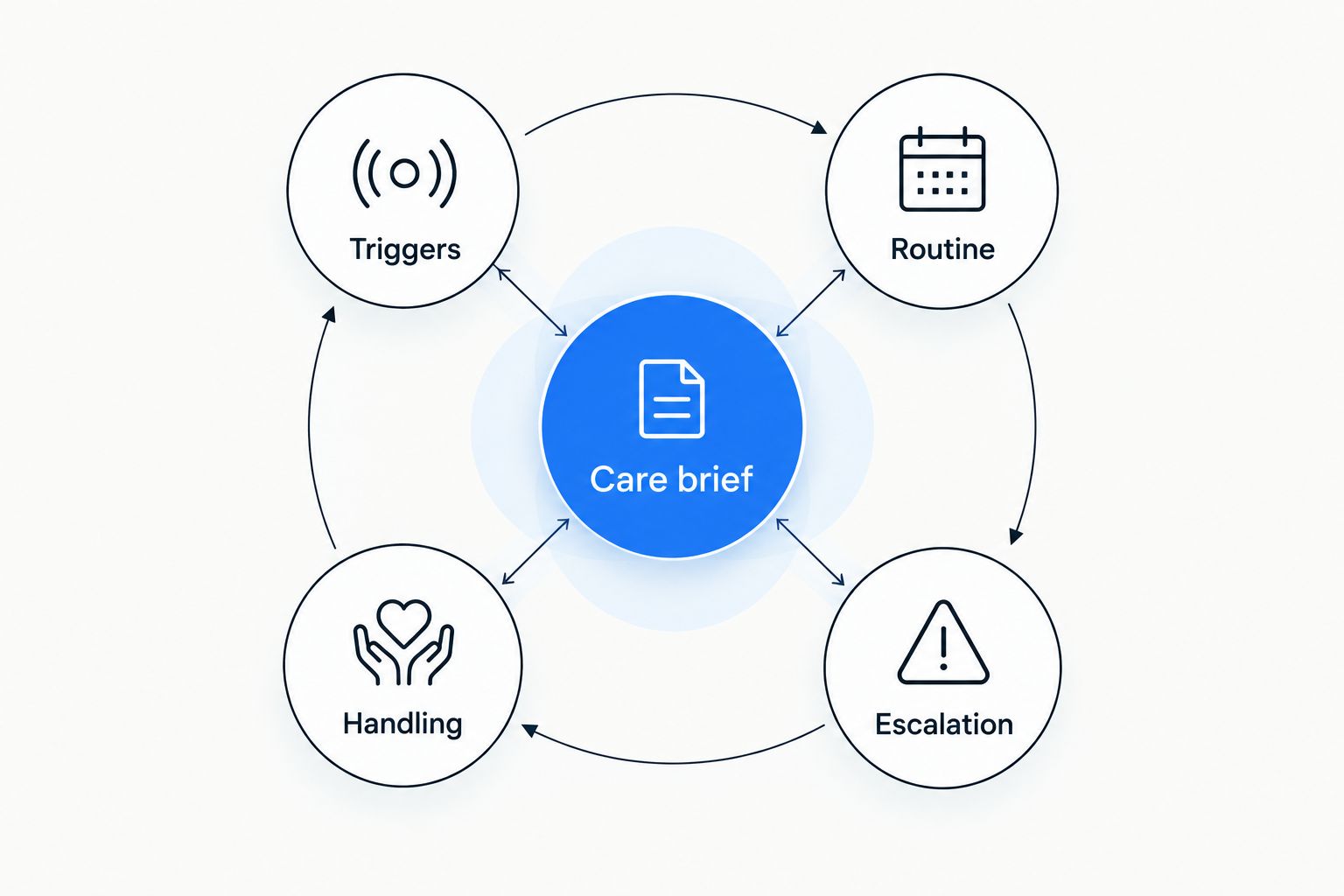
For any 2026 stay, prepare a 1-page care brief that another person can read quickly. Keep observations separate from interpretations: describe scratching at a door rather than writing only that your dog dislikes separation.
Organize the brief under these headings:
- Triggers: Situations that precede barking, pacing, hiding, freezing, or escape attempts.
- Routine: Feeding, toileting, rest, walking, and time normally spent alone.
- Handling: Comfortable approaches, equipment, and situations requiring extra care.
- Escalation: Your contact, a backup contact, and veterinary instructions.
Include 2 human contacts: you and someone authorized to help if you cannot respond. Ask the provider how those contacts are used and how veterinary decisions are handled.
Before committing, get answers to 3 questions: Who notices distress? What changes first? When do you contact me? Specific answers give you something to evaluate beyond reassurance.
How the options are ranked
The order starts with maintaining familiar surroundings, then separates dog-contact needs, medical coordination, household compatibility, and a local boarding enquiry. It does not represent measured outcomes or a claim that one arrangement treats anxiety.
Apply the criteria to your dog, not the rank alone. A dog needing medical coordination belongs in a different decision pathway from a dog who rests comfortably at home with a sitter.
Which care option should you choose?
Start with the arrangement that changes the fewest things your dog finds difficult. Choose home care for a dog helped by familiar surroundings, assess individual boarding for a dog needing distance from others, and involve your veterinarian when health or severe distress shapes the plan.
For Cincinnati travel in 2026, settle the care questions before settling the booking. If a provider cannot explain how the proposed arrangement meets your dog's needs, keep looking rather than relying on a reassuring description.
FAQ
What's the best dog boarding for anxious dogs in Cincinnati?
The best fit depends on your dog's triggers and care needs. Compare familiar-home care, individual boarding, veterinary boarding, and private-home boarding against supervision, rest, handling, and emergency arrangements.
Is a pet sitter better than boarding for an anxious dog?
A pet sitter is a stronger fit when familiar surroundings help your dog and the sitter's coverage matches the dog's needs. A dog distressed by being alone still needs a plan for every absence.
Should an anxious dog join group daycare during boarding?
Group daycare should not be assumed to suit an anxious dog. Discuss the dog's response to unfamiliar dogs and ask whether care without group participation is possible.
Does a boarding facility have someone there all night?
Confirm overnight staffing directly with each provider. Ask whether someone is physically present, how dogs are checked, and what happens when distress is noticed.
Can my dog take anxiety medication while boarding?
Medication during boarding requires instructions from the prescribing veterinarian and confirmation that the provider can follow them. Ask about administration, documentation, and the response to a missed dose or concerning behavior.
What should I tell a boarding provider about my anxious dog?
Describe observable behavior, known triggers, escape attempts, handling concerns, and the dog's normal routine. Include veterinary instructions and emergency contacts rather than relying only on the word anxious.
What if my dog panics or tries to escape when left?
Discuss panic and escape attempts with your veterinarian before choosing a stay. Tell the proposed caregiver exactly what happens so containment, supervision, and treatment needs can be assessed together.
One last thing
Ask every prospective caregiver: What happens if my dog cannot settle? The answer should describe actions, communication, and limits—not simply promise that your dog will be fine.
Share the difficult details before you leave. A candid account of missed meals, door scratching, or handling concerns helps you choose care on the basis of your dog's actual needs.